

Mindfulness has a bit of an image problem.
Mention the word, and some people immediately imagine sitting perfectly still, breathing deeply, and attempting to achieve a level of serenity usually reserved for people who live in mountain retreats.
Meanwhile, they're wondering what to make for dinner, whether they remembered to buy milk, and why the dishwasher is making that noise again.
Adding a mindfulness practice to an already busy day can sound suspiciously like adding another assignment.
But what if you didn't need to make time for an entirely separate activity?
What if you could begin with something you're already doing?
That's one of the things I appreciate about mindful cooking.
It gives us a way to practice paying attention while our hands are occupied with ordinary kitchen tasks.
And it doesn't require us to become particularly peaceful people before we begin.
First, what is mindful cooking?
Mindful cooking involves bringing deliberate attention to the experience of preparing food.
Instead of moving through every task automatically, we occasionally notice what we're doing and experiencing.
That might mean observing the texture of an ingredient.
Listening to the different sounds of the kitchen.
Recognizing when our attention has wandered.
Or noticing how we feel as an activity unfolds.
Mindfulness isn't a competition to see how long we can concentrate without having another thought.
Our attention naturally moves around.
The practice involves recognizing that movement and choosing where to direct our attention next.
And the kitchen offers plenty of interesting places for it to land.
Try this: One task, three moments of attention
For this exercise, choose one simple activity that you'll already be doing.
Perhaps you're preparing vegetables, mixing a salad dressing, or putting together a sandwich.
There's no need to create an extra recipe or turn dinner into a production.
We're simply going to approach one familiar task a little differently.
Moment 1: Notice what you're doing
Before beginning, take a look at the ingredients and equipment in front of you.
What do you see?
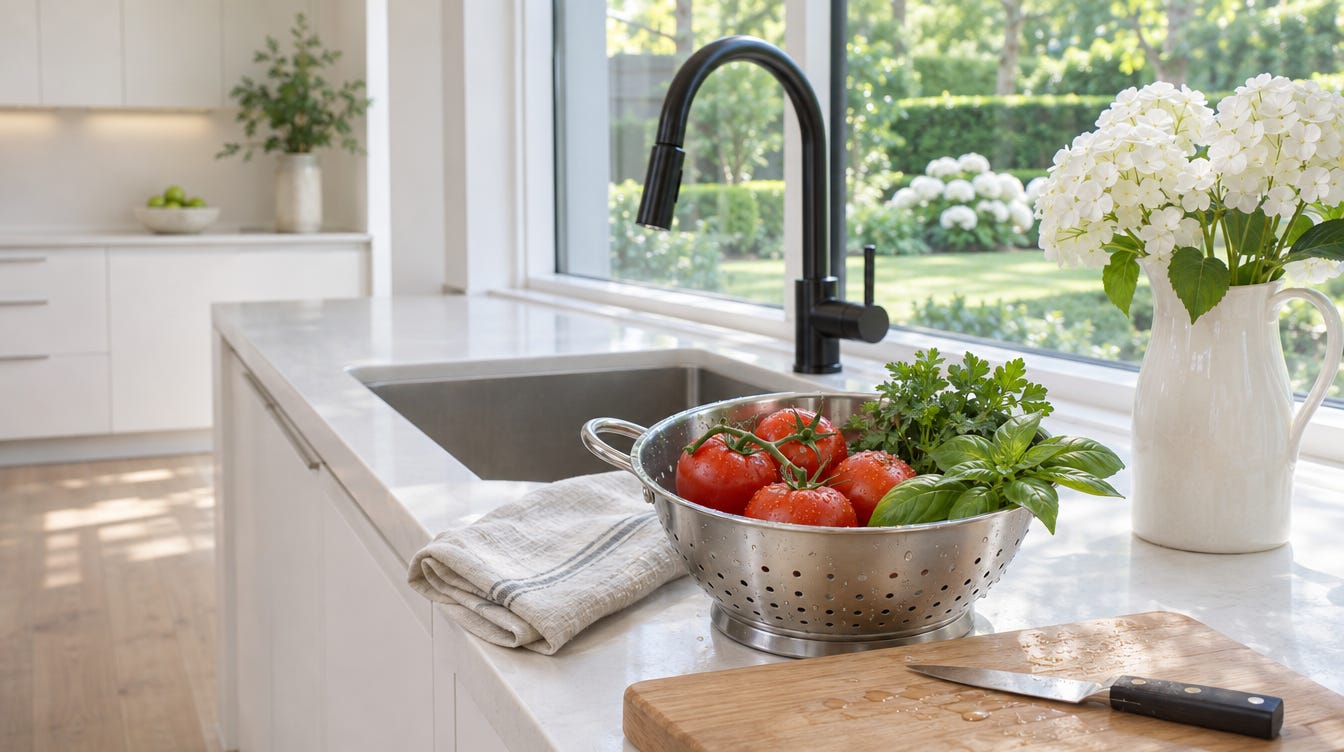
Perhaps the tomatoes are particularly bright.
Maybe the bread has an interesting texture.
Or the herbs smell wonderful when you remove them from their packaging.
Choose one detail and give it your attention.
Not because it has to mean something.
Simply because it's there.
This is the Mindfulness element of my Cooking Therapy approach: becoming more aware of the immediate experience.
Moment 2: Notice how you're doing it
Begin your chosen task.
As you work, become curious about your natural pace.
Are you moving quickly?
Do you enjoy taking your time?
Are you comfortable with the process, or are you concentrating on getting each step right?
You may notice that your attention keeps returning to something entirely unrelated to cooking.
A conversation from earlier.
An appointment tomorrow.
Something you forgot to do.
There's no need to criticize yourself.
Just recognize where your thoughts have gone and return your attention to the task when you're ready.
You might listen to the sound of your knife moving against the cutting board.
Notice the resistance of a vegetable as you slice it.
Or observe the way ingredients change when you mix them.
The point isn't to perform mindfulness perfectly.
It's to experience a familiar activity with a little more awareness.
Moment 3: Notice what happened
When the task is finished, take a moment before rushing to the next thing.
What was the experience like?
Perhaps you enjoyed it.
Maybe you were impatient.
You might have noticed something about your surroundings that you usually overlook.
Or perhaps the activity felt exactly as it always does.
That's information, too.
Mindfulness doesn't require an extraordinary experience.
Sometimes the achievement is simply recognizing what an ordinary one actually feels like.
Where Cooking Therapy takes the experience further
Mindful cooking can be valuable on its own.
But Cooking Therapy goes beyond sensory awareness.
My approach brings together Mindfulness, Metaphors, and Mastery, which I call the 3Ms.
After paying attention to the activity, we may explore whether something about the experience connects with our lives.
For example, perhaps you noticed how much you enjoy taking your time when nobody is rushing you.
Does that connect with a need you've been overlooking elsewhere?
Or maybe you recognized that a task you expected to be difficult was actually well within your abilities.
Does that change how you think about your own capabilities?
These connections should emerge naturally from the experience.
There's no need to manufacture a metaphor simply because you've picked up a potato peeler.
And sometimes the most satisfying part is recognizing that you completed something useful.
That's Mastery.
You prepared something.
You used your abilities.
You accomplished a task.
Those things deserve acknowledgment, even if the result doesn't look like the photograph in a cookbook.
Five everyday places to begin
Once you understand the idea, you'll start noticing opportunities throughout your usual cooking routine.
1. Washing produce
Pay attention to the temperature of the water, the texture of what you're washing, and the movements of your hands.
2. Measuring ingredients
Notice how you approach the task. Do you enjoy precision? Are you comfortable with the process? Is there anything surprising about your reaction?
3. Mixing
Observe how the ingredients change as they combine. Notice the sound, movement, and physical effort involved.
4. Waiting
If you're waiting for something to finish cooking, choose one sensory detail to notice instead of automatically reaching for another distraction. Keep attending to anything that needs monitoring for safety.
5. Presenting the finished food
Take a moment to look at what you've prepared before immediately moving on to the next responsibility.
You don't need to practice all five.
One is plenty.
And if you're preparing something that requires close attention for safety, give the cooking task the attention it deserves.
Mindfulness should make you more aware of what you're doing, not distract you from it.
What if your mind won't settle?
Then you've discovered that your mind is busy.
That's not a failed exercise.
Sometimes we're tired, preoccupied, irritated, or simply not in the mood to slow down.
We don't have to pretend otherwise.
The useful part of mindful cooking is that it gives us something immediate and concrete to return our attention to.
The weight of an ingredient.
The sound of a whisk.
The movement of our hands.
A familiar task unfolding right in front of us.
For some people, active engagement feels more approachable than sitting quietly.
Others may prefer traditional meditation, walking, or an entirely different practice.
There's no need to declare one approach superior.
The goal is to discover what feels useful and accessible to you.
You don't need another thing on your list
I particularly like the fact that mindful cooking can begin with a task you were going to do anyway.
You're not adding a complicated ritual to your day.
You're not required to purchase special equipment.
And you're certainly not expected to turn every meal into an exploration of your deepest emotions.
You're simply creating an opportunity to be a little more present.
If you want to take the experience further, you can introduce the reflective elements of Cooking Therapy.
But you get to choose how much time and attention to give it.
Some days, that might be a complete guided cooking experience.
Other days, it might be thirty seconds spent noticing the feel of an ingredient in your hand.
And some days, dinner is just dinner.
That's perfectly fine.
Explore guided Cooking Therapy experiences
If you'd enjoy a little guidance bringing mindfulness and intentional reflection into your kitchen, my Cooking Therapy app offers therapeutic recipes, short guided audio practices, and a private Kitchen Journal.
The experiences are built around Mindfulness, Metaphors, and Mastery, giving you opportunities to explore your thoughts, feelings, and personal strengths through everyday cooking activities.
You can choose a shorter experience or spend more time exploring, depending on what feels right for you.
Look for Cooking Therapy in the App Store.

Cooking Therapy is intended for personal reflection and supportive self-care. It does not replace professional mental health care.
Cooking Therapy pioneer Debra Borden, LCSW, is the author of four books, including Cooking As Therapy - How to Improve Mental Health Through Cooking. Learn more here about her writing journey, how she became known as The Sous Therapist, and the stories that shape her work.