

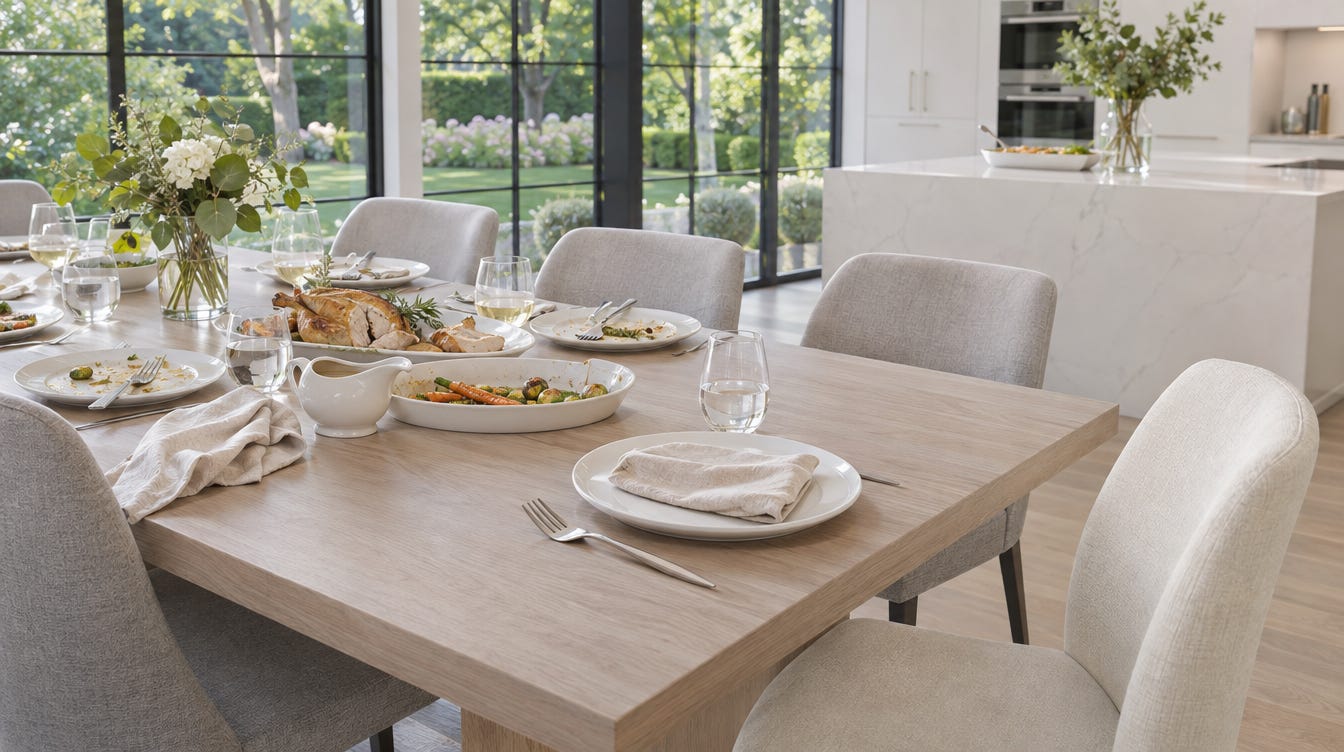
There's always someone who hasn't sat down yet.
Everyone else has a plate. The conversation has begun. Someone is telling a story that's already been interrupted twice, and the person who made the meal is still standing in the kitchen, looking for the gravy boat.
Or another fork.
Or the serving spoon that was absolutely right there five minutes ago.
By the time they finally sit down, someone needs more ice.
Sound familiar?
Holiday meals have a funny way of turning perfectly reasonable people into unpaid restaurant managers.
We plan. We shop. We prepare. We make sure everyone has what they need.
And somewhere along the way, we can become so absorbed in creating an enjoyable experience for other people that we forget we're supposed to be having one, too.
When being helpful becomes a full-time position
There's nothing wrong with enjoying the role of host. Some people genuinely love planning a meal, arranging a beautiful table, and watching guests help themselves to seconds.
It's an expression of creativity, generosity, and affection.
But there's a difference between enjoying what we do for others and feeling responsible for every moment of their enjoyment.
That distinction is worth exploring.
If everyone is perfectly capable of finding another napkin, why do we feel compelled to leap up and retrieve it?
If the conversation is flowing beautifully, why are we worried about whether the coffee will be ready at precisely the right moment?
And if someone offers to help, why does "Oh, no, I've got it!" sometimes escape our mouths before we've even considered the offer?
Perhaps we're proud of being capable.
Perhaps we like having things done a certain way.
Perhaps we've been playing the role of the person who handles everything for so long that accepting help feels unfamiliar.
Or perhaps we're simply enjoying ourselves and don't particularly mind being on our feet.
The important thing is not to assume there's one explanation for everyone.
It's to notice whether the role we're playing is still one we want.
The invisible guest at the table
One of the things I find interesting about gatherings is how easily the person responsible for making everyone comfortable can become almost invisible.
Not because the guests are unkind or unappreciative.
They may be having such a wonderful time that they genuinely don't notice how often their host disappears.
And that's an odd little irony.
The person who brought everyone together is missing the very experience they worked so hard to create.
They hear the laughter from the kitchen.
They catch the end of a story while clearing plates.
They return to find everyone discussing something that apparently happened while they were locating the good coffee cups.
The gathering is a success.
But were they actually part of it?
What if someone else knows where the spoons are?
Here's a small experiment for your next gathering.
If someone offers to help, consider saying yes.
Not because you're incapable of doing the task yourself.
Not because you've earned a break through some officially approved level of exhaustion.
Simply because other people are allowed to participate.
They might put the serving dishes in an unexpected place.
They might fold the napkins differently.
They might even serve dessert before you've had a chance to organize the plates.
Civilization will almost certainly survive.
And something rather nice may happen.
Instead of being the person responsible for creating every pleasant moment, you get to be someone who enjoys a few of them.
You get to sit down.
You get to hear the entire story.
You get to join the conversation rather than supervise it from another room.
There's a place for you, too
Of course, this isn't exclusively about hosting a meal.
It's about the roles we take on in everyday life and the habits that can grow around them.
Sometimes we're the organizer.
The dependable one.
The person who notices what needs doing before anybody else does.
These can be wonderful qualities. There's no reason to stop valuing them.
But it's worth occasionally asking whether we're allowing ourselves to experience the same kindness, enjoyment, and attention we're so willing to offer other people.
You don't have to stop being generous to make room for yourself.
You don't have to stop being capable to accept help.
And you certainly don't have to wait until everyone else is completely satisfied before you're entitled to enjoy your own dinner.
So the next time people gather around your table, take a look at the empty chair.
The one you've been saving for yourself.
It would be a shame to let it go unused.
A question for you: Are you the person who's always up and down during a gathering, or are you very good at letting everyone help themselves?
And if you're a dedicated kitchen supervisor, what's the one job you find hardest to hand over?
If you enjoy these little explorations of the ways we think, feel, cook, and connect, I'd love to have you join me here at Therapeutic Bites.
Subscribe for thoughtful essays, a little laughter, and occasional Cooking Therapy experiences that bring everyday life into the kitchen in some unexpectedly interesting ways.
Cooking Therapy pioneer Debra Borden, LCSW, is the author of four books, including Cooking As Therapy - How to Improve Mental Health Through Cooking. Learn more here about her writing journey, how she became known as The Sous Therapist, and the stories that shape her work.