

Have you ever noticed how much effort we put into appearing as though everything is going beautifully?
We’re fine.
Everything’s fine.
The schedule is manageable, the relationships are harmonious, the house is under control, and we’ve got this whole life business figured out.
Well, except for the laundry, the unanswered messages, the appointment we forgot, and the peculiar noise the car has been making.
But otherwise? Fabulous.
The truth is, nobody lives a perfectly smooth life. We have wonderful days and difficult ones. We feel confident and uncertain, generous and impatient, delighted and disappointed.
Sometimes all before lunch.
And yet we can be remarkably unforgiving of ourselves when those less-than-perfect parts make an appearance.
That’s what makes today’s Cooking Therapy experience particularly interesting.
We’re going to make a smoothie.
But rather than using the ingredients simply to prepare something delicious, we’re going to explore what happens when we stop insisting that every part of ourselves must be equally wonderful.
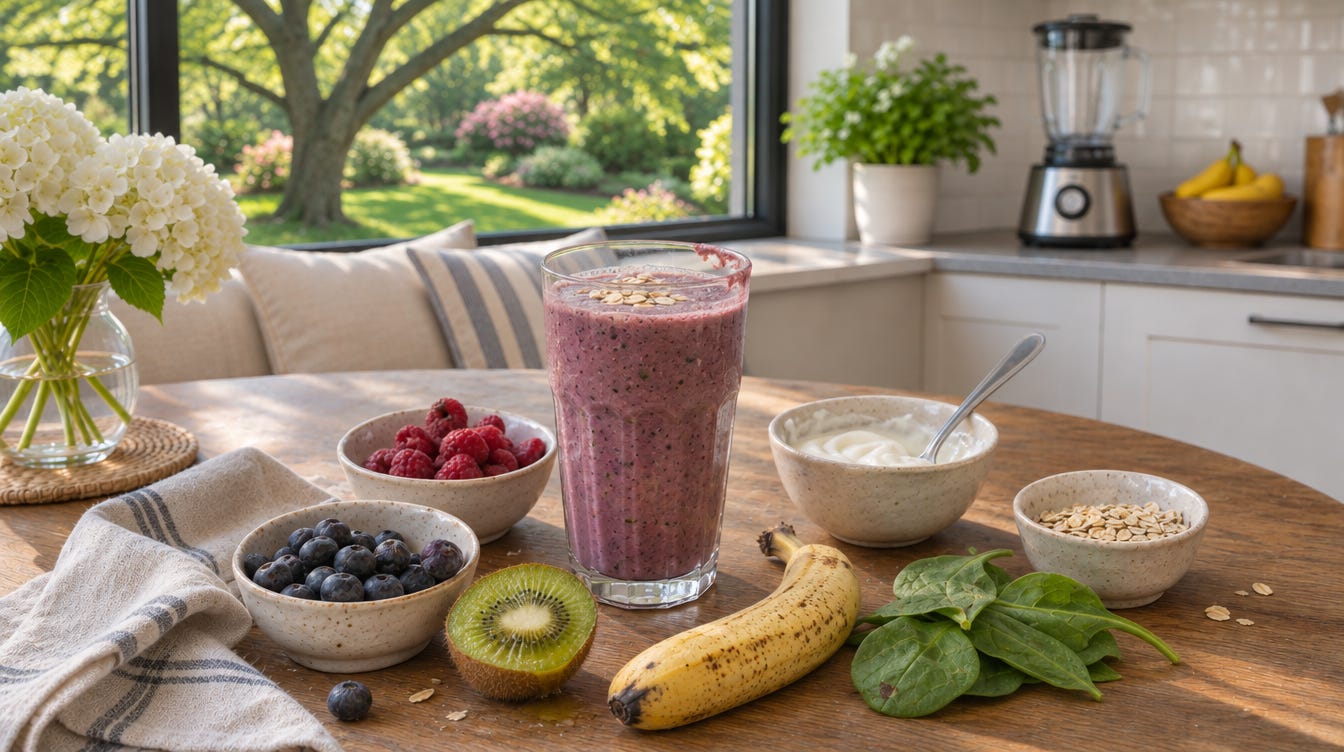
The Recipe: It’s Never All Smooth Smoothie
This recipe comes from the Radical Self-Acceptance session in my book, Cooking As Therapy.
It’s a quick, colorful blend of sweet fruit, creamy yogurt, and a few ingredients that might surprise you.
And that’s precisely the point.
Ingredients
½ frozen banana
½ kiwi
½ cup blueberries
½ cup raspberries
½ cup yogurt of your choice
3–4 spinach leaves
1–2 scoops protein powder
Oats or chia seeds, optional
You’ll also need a blender, a knife, and a glass.
You can make substitutions according to your preferences and dietary needs. The important thing for this experience is having some variety in the flavors and textures.
Before We Begin
In Cooking Therapy, we don’t rush straight to the finished dish.
We begin by giving ourselves a little room to notice what we’re bringing into the experience.
Take a moment to settle into your kitchen.
Clear a comfortable space, wash your hands, and gather your ingredients.
Then ask yourself:
How am I speaking to myself today?
Are you feeling reasonably comfortable with who you are?
Or have you been keeping a mental inventory of everything you should be doing better?
You don’t need to correct your answer. Just notice it.
That’s our starting point.
A Little Sweetness, a Little Bitterness
Begin with the banana and kiwi.
Peel and cut the kiwi, then add it and the banana to your blender.
Notice the different textures. The banana is soft and creamy, while the kiwi has its own distinctive little seeds and tangy flavor.
Now wash the blueberries and raspberries.
Look at those colors!
There is something wonderfully appealing about putting different fruits together. Each contributes something of its own, and we wouldn’t necessarily want them all to taste alike.
As you add the berries, consider something you genuinely appreciate about yourself.
It doesn’t have to be an extraordinary talent or a magnificent accomplishment.
Maybe you’re a good listener.
Maybe you have a terrific sense of humor.
Maybe you can find a creative solution to a problem that has everyone else scratching their heads.
Whatever it is, give it a moment of recognition.
Now add the spinach.
Yes, spinach.
Those few green leaves introduce a different flavor to an otherwise sweet collection of ingredients.
And here’s where we can explore a metaphor.
Most of us are perfectly willing to celebrate our pleasant qualities. We’re a little less enthusiastic about acknowledging that we can also be stubborn, cranky, impatient, or occasionally spectacularly unreasonable.
But these are human experiences, too.
They don’t automatically cancel out the qualities we value in ourselves.
Can you acknowledge something imperfect about yourself without turning it into a judgment about your entire character?
That’s worth considering while those spinach leaves join the fruit.
The Parts That Support Us
Spoon the yogurt into your blender.
Notice how its creamy texture changes the mixture. The ingredients are beginning to come together, although they still look like a rather peculiar collection.
Add the protein powder.
For this part of the experience, consider the qualities that help support you when life becomes difficult.
Maybe it’s persistence.
Maybe it’s your ability to ask for help.
Perhaps it’s curiosity, patience, resourcefulness, or your willingness to try again when something doesn’t work the first time.
You don’t need to possess every admirable quality in equal measure.
You needn’t even feel particularly strong today.
Simply recognize one personal strength that has been useful to you.
And give yourself credit for it.
Now, Blend
Secure the lid and blend everything until smooth, stopping as needed to scrape down the sides or adjust the consistency according to your blender’s instructions.
Watch what happens.
The individual ingredients become a completely different creation.
You can no longer distinguish every berry or spinach leaf, but each has contributed something to the finished drink.
There isn’t one ingredient responsible for the entire result.
And there isn’t one quality, one mistake, one disappointing afternoon, or one imperfect decision that defines an entire person.
Pour your smoothie into a glass.
If you like, sprinkle a few oats or chia seeds over the top.
They’ll add a little texture.
After all, the name of this recipe is It’s Never All Smooth Smoothie.
We might as well celebrate a few bumps.
The Most Important Part Comes After the Blending
Here’s where we move beyond simply making a smoothie.
In Cooking Therapy, the experience itself matters, but so does what we take away from it.
We’ve practiced Mindfulness by paying attention to the ingredients, the physical process, and our own thoughts.
We’ve explored Metaphors through the mixture of sweet, tart, soft, and less-sweet ingredients.
And now we come to Mastery: recognizing what we’ve done, completing the experience, and considering what we might carry into everyday life.
As you enjoy your smoothie, give yourself a little time with these questions:
What part of myself have I been judging too harshly?
What positive quality do I sometimes overlook because I’m so busy noticing my shortcomings?
What might change if I allowed myself to be a whole person rather than a perfectly polished one?
There’s no requirement to arrive at a dramatic revelation.
You may simply recognize that you’ve been a bit hard on yourself lately.
That alone can be a useful observation.
And if you’d like to carry something from this session into the coming days, consider choosing one small way to respond to yourself with greater fairness when things don’t go as planned.
Not endless praise.
Not pretending everything is wonderful.
Just a little more willingness to recognize that being imperfect is part of being human.
A Final Thought
I find it rather amusing that we spend so much time trying to smooth out our lives when some of the most interesting things about us are the very qualities that make us different.
Our quirks.
Our unexpected combinations.
Our occasional tartness.
Our distinctive flavors.
Imagine how dull the world would be if everyone had exactly the same personality.
Or if every smoothie contained nothing but banana.
There’s room for a little variety.
There’s room for some texture.
And there’s certainly room for you, exactly as you are, while continuing to learn and grow.
Now, how’s that smoothie?
This Cooking Therapy experience is adapted from the Radical Self-Acceptance session in my book, Cooking As Therapy. The practice combines Mindfulness, Metaphors, and Mastery to encourage intentional reflection through everyday kitchen activities. It’s an opportunity for personal exploration, not a substitute for professional mental health care.
If you’d like more Cooking Therapy experiences, recipes, and reflections, download the free Cooking Therapy app. I’d love to welcome you to the kitchen.

Cooking Therapy pioneer Debra Borden, LCSW, is the author of four books, including Cooking As Therapy - How to Improve Mental Health Through Cooking. Learn more here about her writing journey, how she became known as The Sous Therapist, and the stories that shape her work.