

"Are you going to cut them that way?"
Six innocent words.
Possibly the beginning of a perfectly pleasant conversation about vegetables.
Possibly the beginning of a domestic incident involving a cutting board.
It all depends on the tone, the history, and whether the person holding the knife has already been asked four times if they're sure they know what they're doing.
Cooking together sounds wonderfully romantic in theory.
Two people preparing a meal.
A little music.
Some laughter.
One person stirring while the other chops.
In reality, cooking together can reveal just how differently two perfectly reasonable people approach the same task.
And that makes the kitchen a fascinating place to explore communication.
There isn't always one right way
One person reads every recipe from beginning to end before starting.
The other glances at the ingredients and begins.
One measures carefully.
The other considers measuring spoons an unnecessary restriction on artistic expression.
One cleans continuously.
The other promises to clean everything at the end, a promise that may or may not survive dessert.
None of these differences necessarily indicates a relationship problem.
But the way we respond to them can be revealing.
When someone does a familiar task differently, do we become curious?
Do we immediately correct them?
Can we tolerate a result that's different from what we imagined?
Or do we quietly take over because it seems easier than explaining?
These questions aren't limited to cooking.
They show up in household responsibilities, shared projects, family decisions, and all sorts of ordinary interactions.
The difference between helping and supervising
Imagine you've asked someone to prepare the salad.
They agree.
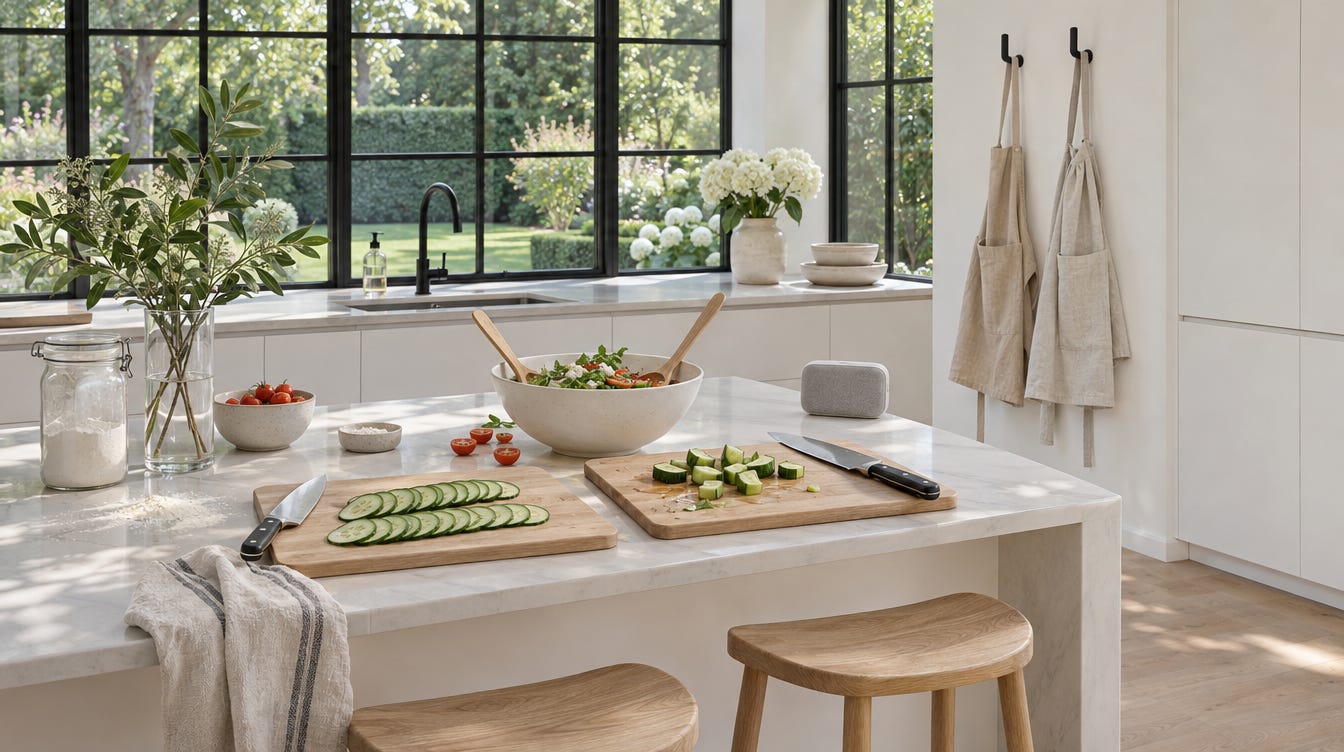
Then you spend the next ten minutes explaining which knife to use, how thinly to slice the cucumber, where to put the tomatoes, and why their choice of bowl is questionable.
You've technically delegated the task.
But you haven't really handed it over.
This is one of those situations where a well-intentioned desire to help can begin feeling like criticism to the person receiving it.
Of course, sometimes instructions genuinely matter.
Kitchen safety matters.
Food allergies matter.
And if someone is about to put a plastic container directly onto a hot burner, by all means, speak up.
But when the issue is simply that the cucumber slices aren't the shape you prefer, it may be worth considering whether a correction is necessary.
There's a difference between protecting a meal and protecting a preference.
What are you actually trying to communicate?
Suppose someone says, "You always make such a mess when you cook."
What might they actually mean?
Perhaps they're tired of cleaning the kitchen.
Perhaps they feel their work isn't appreciated.
Maybe they're frustrated because they've discussed cleanup before and nothing has changed.
Or perhaps they're simply irritated by a countertop covered in flour.
The statement tells us something about the speaker's frustration.
But it doesn't necessarily tell the other person what would help.
Compare it with:
"Could we agree to clean up together after dinner? I'd really appreciate not being left with everything."
That's a different conversation.
It identifies a need rather than assigning a character flaw.
It also gives the other person something concrete to respond to.
We won't always communicate perfectly, especially when we're hungry, tired, or standing beside a sink full of dishes.
But noticing the difference between criticism and a specific request can be useful.
A Cooking Therapy experiment for two
If you'd like to explore this together, choose a simple recipe that allows both people to participate comfortably.
Nothing elaborate.
Nothing that requires special equipment or a forty-five-minute argument about technique.
Before beginning, agree on three things.
First: Who's doing what?
Make the division of tasks clear enough that neither person is constantly wondering whether they're supposed to intervene.
Second: What actually requires agreement?
Perhaps the timing matters because the dish needs to cook properly.
Perhaps an ingredient matters because of an allergy.
But the size of the carrot pieces may be a matter of preference.
Recognizing the difference can eliminate a surprising amount of unnecessary commentary.
Third: How will you handle suggestions?
You might try asking, "Would you like a suggestion?" before offering one.
It's a small question, but it gives the other person room to accept or decline.
Then cook.
As you go, pay attention to the experience.
Notice whether you feel comfortable letting the other person make decisions.
Notice whether you find it easy to ask for what you need.
Notice whether the experience feels cooperative, competitive, playful, or tense.
There's no need to turn the evening into an evaluation of your entire relationship.
You're simply observing an ordinary interaction with a little more intention.
A conversation worth having afterward
When the meal is finished, each person can answer these questions:
What did I enjoy about working together?
Perhaps you appreciated having company.
Perhaps someone contributed an idea you wouldn't have considered.
Maybe you enjoyed watching the other person take responsibility for a task.
Was there a moment when I felt corrected, overlooked, or frustrated?
Try describing the actual moment rather than making a sweeping statement about the other person's personality.
And finally:
What's one thing we could do differently next time?
Not ten things.
Not a comprehensive performance review.
Just one.
You may discover that a small adjustment would make the experience more enjoyable for both of you.
Or you may decide that you work best with one person cooking while the other sets the table.
That counts as cooperation, too!
Cooking together isn't the same as doing everything together
I want to emphasize something here.
The goal isn't to transform every couple or family into an enthusiastic culinary team.
Some people love sharing kitchen responsibilities.
Others prefer their own space.
And some relationships operate beautifully with one person handling dinner while the other contributes in entirely different ways.
The meaningful question isn't whether everyone enjoys the same activity.
It's whether the arrangement feels respectful, understood, and reasonably satisfying to the people involved.
Cooking Therapy offers one way to explore those patterns through real experiences.
Instead of discussing communication only as an abstract idea, we get to notice it while making decisions, sharing tasks, responding to differences, and seeing what happens.
There may be discoveries worth carrying into other areas of life.
And if all you discover is that your partner should never be allowed near your favorite knife, well, perhaps that's useful information, too.
Explore more with Cook Yourself Happy
If you're interested in exploring your relationships, everyday patterns, and emotional responses through intentional cooking experiences, my Cook Yourself Happy course offers a more structured way to begin.
The course explores four areas of life: Relationships, Family, Stress, and Self-awareness, with hands-on Cooking Therapy modules and accompanying reflection worksheets.
You'll have guided activities designed to help you examine your experiences and consider what you might take from the kitchen into everyday life.
It's a wonderful opportunity to explore the connections between what we do, how we respond, and what we might want to understand more clearly about ourselves.
Explore the Cook Yourself Happy course.
Cooking Therapy pioneer Debra Borden, LCSW, is the author of four books, including Cooking As Therapy - How to Improve Mental Health Through Cooking. Learn more here about her writing journey, how she became known as The Sous Therapist, and the stories that shape her work.