

Have you ever looked at someone else's life and wondered how they manage to have everything so beautifully arranged?
Their relationships appear effortless.
Their house is always lovely.
Their children, if they have them, seem remarkably cooperative.
And judging by the photographs, they've never encountered a bad hair day, a disappointing vacation, or a kitchen counter covered in unpaid bills.
Meanwhile, back in reality, you're looking at your own perfectly ordinary life, complete with its unfinished business and occasional disasters.
It's a rather unfair comparison, isn't it?
You're comparing everything you know about your own life with the small portion of someone else's life they've chosen to show you.
Which brings me to popovers.
Yes, popovers.
Stay with me.
What a popover knows about appearances
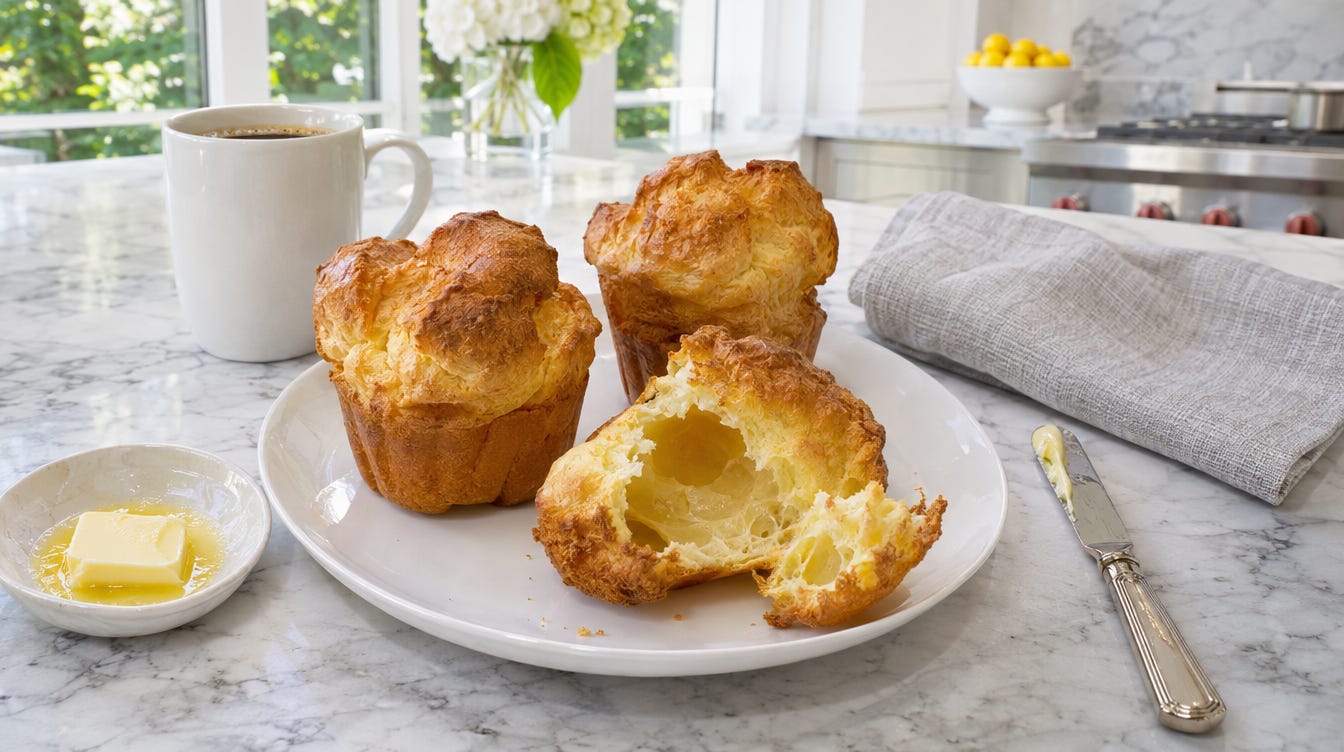
If you've never made one, a popover is a wonderfully theatrical little creation.
You begin with a rather ordinary batter of eggs, milk, and flour.
Nothing especially impressive.
Then something delightful happens in the oven.
The batter rises into a magnificent, golden, puffed-up pastry that looks as though it has very important things to say about itself.
It's quite the transformation.
But when you cut into it, you discover that much of its impressive size is air.
Now, I'm not suggesting we begin describing people as pastries.
Although there are occasions when the comparison might be tempting.
What interests me is how effectively a popover demonstrates the difference between what we see on the outside and what may actually be happening underneath.
And that makes it a wonderful starting point for exploring perspective.
A little Cooking Therapy before we begin
In my book, Cooking As Therapy, I included a session called Perspective Popovers.
It was one of the first Cooking Therapy sessions I developed, and it uses a familiar kitchen activity to explore the way our perceptions shape our experiences.
The exercise is built around my 3M approach: Mindfulness, Metaphors, and Mastery.
We pay attention to the experience of cooking.
We consider what the process might represent.
And we recognize what we've accomplished.
Most importantly, we don't have to arrive at some predetermined emotional conclusion.
The purpose is to explore our thinking with a little more curiosity.
And at the end, we have popovers.
Which is an excellent bonus.
Let's make Perspective Popovers
Adapted from the Perspective Popovers session in Cooking As Therapy.
Makes: 6 popovers
You'll need: A six-cup popover pan or muffin pan, a mixing bowl, and an electric mixer.
Ingredients
1¼ cups all-purpose flour
¼ teaspoon salt
3 large eggs
1¼ cups milk
2 tablespoons unsalted butter, divided into six pieces
1 tablespoon unsalted butter, melted
Nonstick spray for the pan
Step 1: Prepare the pan and consider your starting point
Lightly coat the pan with nonstick spray and preheat your oven to 400°F.
Before you begin mixing, think of a situation that has been troubling you.
Perhaps you've been making assumptions about what someone thinks of you.
Perhaps you're comparing yourself with someone who seems to be managing life more successfully.
Or perhaps you've become convinced that a particular situation can only be understood one way.
You don't need to solve anything yet.
Just identify the thought you'd like to examine.
Step 2: Measure what belongs in the picture
Place the flour and salt in a mixing bowl.
As you measure, consider whether you've been giving equal attention to the different parts of your life.
When something is bothering us, it can become remarkably good at occupying the entire picture.
What else is there that deserves acknowledgment?
A relationship you value?
Something you've handled well?
A quality you appreciate about yourself?
None of these things makes the difficult situation disappear.
But they belong in the picture, too.
Step 3: Mix the batter
Add the eggs and milk, then beat the ingredients until smooth, incorporating the melted butter.
Listen to the sound of the mixer.
Watch the individual ingredients become a unified batter.
And consider how many different thoughts, feelings, experiences, and circumstances can be part of the same situation.
It may be more complicated than the single explanation you've been giving yourself.
That's not necessarily a problem.
Sometimes complexity is simply reality.
Step 4: Prepare the hot pan
Warm the empty pan in the oven for approximately two minutes.
Carefully remove it, place one piece of butter in each cup, and return it to the oven for about another minute, until the butter melts.
Take a moment during the waiting.
There's nothing you need to accomplish in that minute beyond noticing where your attention goes.
If your thoughts drift back to the situation you identified earlier, you might ask yourself:
What do I actually know?
And what am I assuming?
Those are two very different questions.
Step 5: Fill and bake
Carefully remove the hot pan and divide the batter among the six cups, filling each approximately halfway.
Bake at 400°F for 20 minutes.
Then reduce the temperature to 300°F and continue baking for another 20 minutes.
While the popovers rise, consider the possibility that you don't yet have the complete picture.
You don't have to replace every uncomfortable thought with a cheerful one.
You don't have to persuade yourself that everything is wonderful.
You can simply leave room for the possibility that another interpretation exists.
Step 6: Look inside
When the popovers are golden and beautifully puffed, remove them from the oven.
Take a moment to admire what you've made.
They really are rather impressive.
Then cut one open.
Look at that!
All that height and grandeur, and an interior filled with air.
It's a wonderful visual reminder that appearances don't always tell us the entire story.
We know this intellectually, of course.
But sometimes experiencing an idea through something tangible gives us a new way to remember it.
What did you discover?
Before you finish, return to the situation you thought about at the beginning.
Ask yourself three questions:
What was I assuming?
Was I treating an interpretation as though it were an established fact?
What might I not know?
Could there be circumstances, feelings, or information I haven't considered?
What would a more balanced perspective look like?
Not necessarily a positive perspective. Just one that makes room for more of the picture.
You may discover something useful.
You may decide your original interpretation was quite reasonable.
Or you may recognize that you need more information before deciding what something means.
All of those are legitimate outcomes.
Cooking Therapy isn't about forcing a happy ending onto every situation.
It's about creating an opportunity for meaningful reflection.
And sometimes an airy little pastry provides a surprisingly memorable place to begin.
Take it into your day
The next time you find yourself comparing your life with someone else's, remember your popover.
The beautifully puffed exterior.
The unexpected interior.
The difference between what you imagined and what you discovered when you looked more closely.
You don't know everything about someone else's experience.
And there's probably more to your own story than the single difficult moment you've been concentrating on.
Now, would anyone like a popover?
I'd love to know: Have you ever discovered that something you were absolutely certain about turned out to be quite different from what you imagined?
This Cooking Therapy experience is adapted from the Perspective Popovers session in my book, Cooking As Therapy. It combines intentional cooking and reflection using Mindfulness, Metaphors, and Mastery. It is an opportunity for personal exploration, not a substitute for professional mental health care.
If you'd like more Cooking Therapy experiences, guided audio practices, and a private place to reflect, explore my Cooking Therapy app.
It's an invitation to bring a little more intention, curiosity, and self-discovery into your own kitchen.
Look for Cooking Therapy in the App Store.

Cooking Therapy pioneer Debra Borden, LCSW, is the author of four books, including Cooking As Therapy - How to Improve Mental Health Through Cooking. Learn more here about her writing journey, how she became known as The Sous Therapist, and the stories that shape her work.